Season guide · July 31, 2026
A patterned dress in a patterned room
the stil editorial team · 2 min read
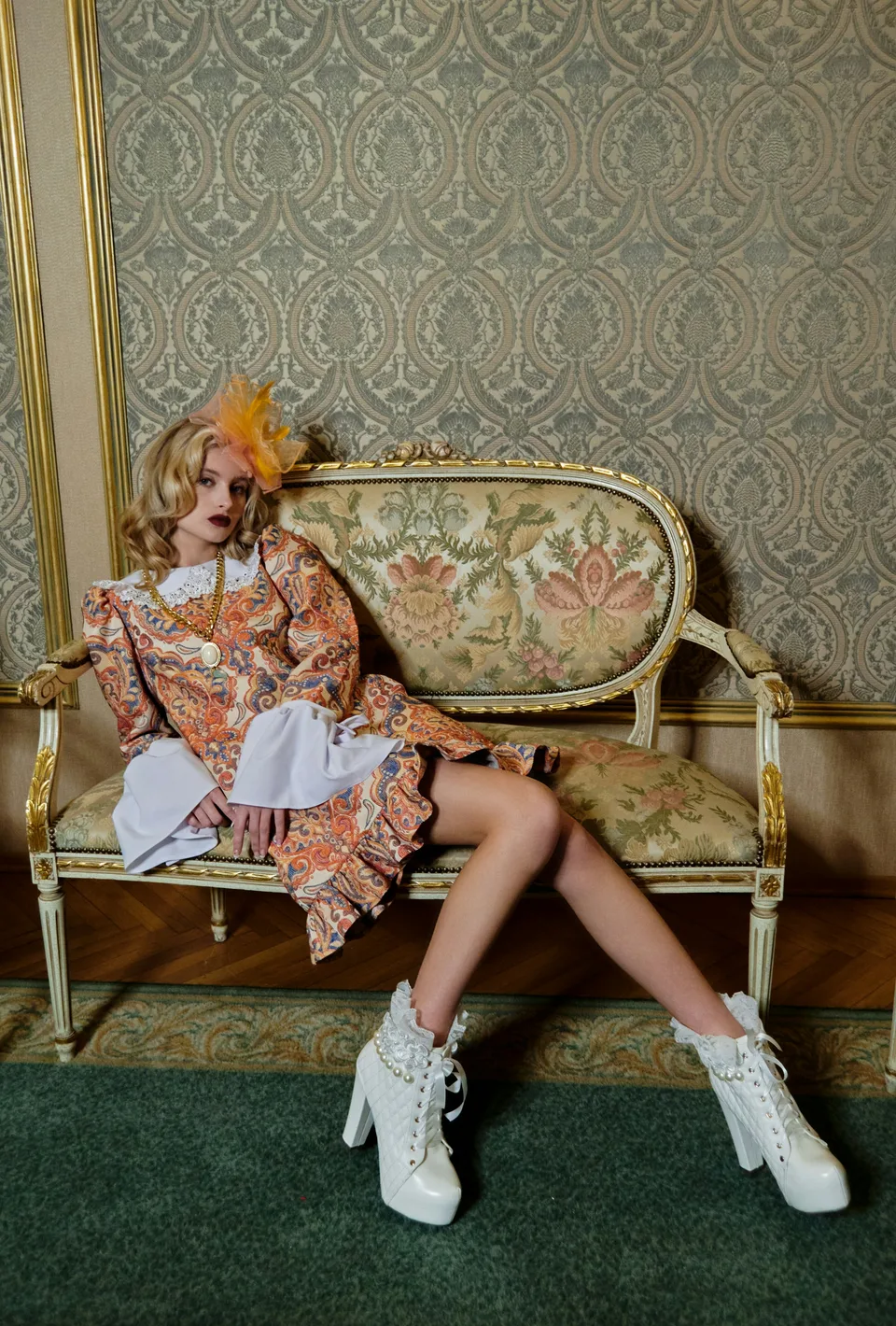
Most guides dispose of pattern on pattern in a single sentence: don't. This photograph does the opposite and does not fall apart. There aren't even two patterns in the frame; there are three.
The rule isn't wrong, only unfinished. The trouble was never the number of patterns, it is how they are kept apart from one another. In this room three separations do that work at once.
Three patterns, three scales
The wallpaper's motif is large: a single repeat runs nearly the length of an arm. The tapestry's flowers are mid-sized, about a palm across. The paisley on the dress is small, closer to the stone in a ring. All three sit in one frame and none can be mistaken for another, because the eye has to focus at a different distance to resolve each one.
Trouble starts when two patterns at the same scale land side by side. Both call the eye to the same depth, and it stops being clear where either one ends. A difference in scale is how patterns get arranged one behind the other instead of stacked on top of each other.
Color makes the second separation
Everything in the room is faded: the wallpaper pulled toward a grayish green, the tapestry into cream and powder pink, the wood and the carpet at the most tired version of their own tones. The dress is the only saturated thing here. Its orange is genuinely orange, its blue genuinely blue.
What sends the room to the back is not that it is plain; it is that it is quieter. That distinction earns its keep, since the room is rarely ours to choose. When the seat waiting for us is in front of a patterned wall, on a tiled floor, or inside a flowered armchair, the most useful tool at hand is a difference in saturation.
What the white collar is doing
Easiest to miss is the third separation. The dress's collar and cuffs are plain white lace, and those white fields draw a border for the pattern to stop at. Without them the paisley would touch the tapestry's flowers directly at the shoulder and the wrist, and the two patterns would run into each other.
The same job repeats at the other end of the outfit: the boots are plain white. The figure ends up framed in flat color above and below, so the pattern in the middle stays inside its own field. The orange feather in her hair is no accident either. It is the dress's orange exactly, tying the head back to the body without introducing a fourth idea.
That leaves three cards to play whenever a patterned piece has to walk into a patterned room: change the scale, change the saturation, add a plain border. This photograph plays all three at once, which is why something that ought to look reckless sits there entirely calm.
- pattern
- outfit
Photo: Ola Szkolda / Unsplash